Mayor Cogswell, the Altman Appointee, and Closing the Courthouse Door
The rental house at the center of this tenant-exploitation lawsuit financially benefits Jonathan S. Altman, who advises Mayor Cogswell on affordable housing from the Homeownership Initiative Committee.
On March 27, 2026, Plaintiffs put the Mayor on notice. The same week, court staff branded a disabled pro se litigant's all-parties safety filing "ex parte and not allowed," while the same litigant's formal ADA accommodation request sat unanswered for nearly two months - and defense counsel's remote-hearing request, one of the ADA accommodations requested January 20, 2026, and never granted, was promptly accommodated.
Documents Overview
Charleston County Court of Common Pleas, Case No. 2025-CP-10-05095
Filing Date: March 27, 2026
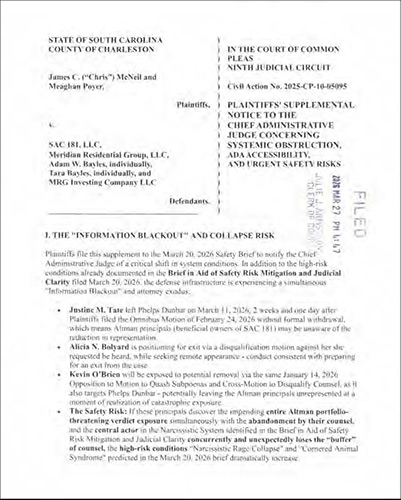
Document: Plaintiffs' Supplemental Notice to the Chief Administrative Judge Concerning Systemic Obstruction, ADA Accessibility, and Urgent Safety Risks
Contents: Notice of administrative gatekeeping as an ADA barrier, notice of political escalation, and Exhibit A; the same-day Notice of Intent to Mayor William Cogswell.
Court Staff and Counsel Email Thread
Date: March 27, 2026 (court-staff & chambers email thread, all counsel CC'd)
Document: Court-Staff and Mayor Notification; Van Slambrook Brief Thread
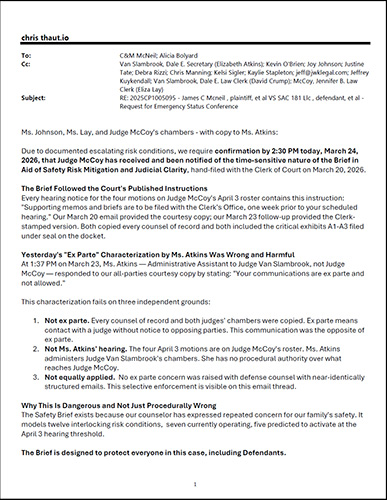
Contents: The full all-parties email thread documenting the "ex parte" characterization, the contrasting same-thread Webex accommodation granted to defense, and the notification routed to the Mayor's office.
Executive Summary
At 1:37 PM on March 23, 2026, an administrative assistant in Charleston, SC Court of Common Pleas Chief Administrative Judge Van Slambrook's chambers told a pro se litigant - whose all-parties email about escalating unsafe conditions copied every counsel of record and two judges' chambers - that "Your communications are ex parte and not allowed.
Any communication with the Court should be pursuant to a properly noticed hearing."
Sixty-two minutes later on that same email thread, defense counsel asked to appear remotely by WebEx at the upcoming hearing - which was identical to one of several ADA Accommodations requested by Plaintiffs to counter clinically documented PTSD (PCL-5 76–80, severe range) that was incurred in the course of this litigation, through alleged multi-party coordinated harassment and gaslighting. The defense attorney was accommodated three days later.
The communication labeled "ex parte" was the procedural opposite of ex parte: ex parte means contact with a judge without notice to opposing parties, and this thread gave notice to all of them, bringing up first-amendment chilling constitutional issues.
And since Ms. Atkins also wrote that "Any communication with the Court should be pursuant to a 'properly noticed hearing', it should be noted that is not the rule - and cannot be. The Court's own hearing notices instructed parties to file briefs with the Clerk a week in advance, and - as we note here - defense counsel made informal scheduling requests on this very thread without objection.
Applied only to the pro se litigant, the instruction is a closed loop: you cannot notice a hearing without contacting the Court, yet contacting the Court is declared "not allowed" without a noticed hearing. It effectively locks the door while chilling constitutionally protected speech petitioning the government.
Applied only to the pro se litigant, the instruction is a closed loop: you cannot notice a hearing without first contacting the Court, yet contacting the Court is declared "not allowed" absent a noticed hearing. The result chills constitutionally protected speech and the right to petition the government — and reserves access for those who already hold the key.
The "Ex Parte" That Wasn't
Five Independent Grounds the Communication Fails
- It Misdefines Ex Parte: Every counsel of record and both judges' chambers were copied. The message was, by definition, the inverse of Ex Parte.
- Not That Staffer's Hearing: The four April 3 motions sat on Judge McCoy's roster. The assistant administers Judge Van Slambrook's chambers and held no procedural authority over what reached Judge McCoy.
- Not Equally Applied: No "ex parte" concern was raised with defense counsel for materially identical emails. The selective enforcement is visible on the face of the single thread.
- It Conflates Communication with Adjudication: You do not need a formal "properly noticed hearing" just to email an administrator about safety accommodations or logistics. Hearings are for arguments and legal rulings, not for setting up basic procedural conditions.
- It Blocks Access to the Court: Telling a self-represented (pro se) litigant they cannot communicate with the administration outside of a formal hearing effectively cuts off your right to request basic procedural adjustments or report harassment.
Plaintiffs documented a 76/80 PCL-5 PTSD score and a pending ADA accommodation request including the same virtual-appearance courtesy that defense received promptly. As of March 30, that ADA filing would be two months old without a ruling.
The pattern - defense communications welcomed, plaintiff safety filings turned away at the door - is the courthouse expression of what the Housing Justice Audit names the Ask<-->Harm Loop: the system's front door filters out the Most Vulnerable Member (MVM) while protecting the passive-investor interests behind the case.
The Political Gravity: Cogswell and the Altman Appointee
The same day Plaintiffs filed the Supplemental Notice, they sent Mayor William Cogswell a formal Notice of Intent (filed as Exhibit A), copying the Chief of Staff, Clerk of Council, City Attorney, two City Council members, and the City's communications leads. That letter placed the City on notice - with prior knowledge dating to a March 10, 2026 communication - that the litigation at 181 Gordon Street is connected to Jonathan S. Altman, the Mayor's affordable-housing appointee and a beneficiary of defendant SAC 181, LLC.
What the Record Documents
- A 95% stock devaluation: Jonathan S. Altman signed off on a roughly 95% devaluation of the Altman family's Charles Realty Company, Inc. stock between 2006 and 2021 - a period of historic Charleston commercial real-estate appreciation. For more on that, see The Altman Files: When Public Trust Meets Private Extraction
- A $350K probate valuation gap: A documented discrepancy between probate filings and the commercial reality of the property at the heart of the tenant-exploitation lawsuit - detailed at Court Memo Details $350K Probate Valuation Gap.
- The choice put to the administration: The letter offered the City a window to lead toward a Conscious Co-Stewardship model - or to watch "Project 3500" be remembered as "Project 350K."
This is where the courthouse door and City Hall connect. When administrative staff filter a disabled litigant's safety filing while waving through opposing counsel, and a beneficiary of the house at the center of that litigation holds a public appointment tied to the very valuation gap under audit, the question becomes one of undermining public trust through alignment with the private extraction that comes from the Unconscious Abdication belief system at the heart of what's called Passive Investing.
The Second Continuance and the Stalled Amended Complaint
Judge McCoy's March 26 continuance was the second she granted in this case (Exhibit E). The first, in November 2025, was obtained through defense counsel's fabricated consent and enabled three additional months of obstruction.
The March 26 letter routed the case back to the Chief Administrative Judge on an assignment question - even though that judge had already convened and presided over the February 9, 2026 scheduling hearing in this matter. Meanwhile, the Motion for Leave to file the Second Amended Complaint - which adds Charleston legal-community insider Charles S. Altman in his individual capacity and the image counts central to this case - had sat unopposed on the docket since October 24, 2025: 154 days as of March 27.
The Long Limb Only Holds for So Long
Picture a troop of monkeys edged far out on a long limb, high over a river of crocodiles, reaching for a fruit that supposedly raises the whole tribe's standing in the jungle. From the ground, no one can tell the "rare fruit" is really just a cluster of thorny cones - so the tribe keeps up the story that it alone can reach the exotic prize.
It is the long branch that makes the prize reachable, and the branch has held so far - so what's one more monkey? A new arrival tests it: it seems to hold. And, once up there, crawling out is far easier than climbing down the rough trunk to the bank. There is even a thrill to being high up, swaying on the limb. There's even a mood of camaraderie in discovering and joining the "secret".
Yet,the wise monkey standing on the riverbank sees the rest: a branch that holds only because nothing has yet exceeded its load. But it will, when overloaded, snap ... dropping every monkey on it, screaming, into the river full of a green, swirling mass of hungry crocodiles in feeding frenzy, all at once.
What is the price of pretending to hold the best fruit in the jungle? What is the price of joining the lie?
- Nothing, as long as the branch holds.
- Everything, the moment it breaks - for everyone on the branch.
A captured false-frame system operates the same way: by recruiting more participant to crawl to the end of a long limb that holds only until the size of the captured system is too much weight for the tree to hold. It works until it doesn't, and it breaks all at once.
For questions about these filings and the City's notice, contact:
Chris McNeil, Pro Se Plaintiff
Email: Click here to email with web form
Case: 2025-CP-10-05095, Charleston County Court of Common Pleas
Document Access
Plaintiffs' Supplemental Notice to the Chief Administrative Judge (March 27, 2026) — incl. Exhibit A: Notice to Mayor Cogswell
To Top
 Unable to view the pdf on your mobile device?
Download the PDF
Court-Staff & Mayor Notification — Van Slambrook Brief Thread (March 27, 2026)
To Top
 Unable to view the pdf on your mobile device?
Download the PDF