
Discovery Is Not a Word Game: Motion to Determine Sufficiency of Defendants’ RFA Response

When “vague and ambiguous” becomes a strategy, Requests for Admission stop narrowing issues and start hiding them. Motion seeks court intervention after defendants deployed coordinated "vague and ambiguous" boilerplate to avoid clean admissions.

Document Overview

Charleston County Court of Common Pleas Case number: 2025-CP-10-05095
Filing Date: December 23, 2025
Document filed: Plaintiffs’ Motion to Determine Sufficiency of Answers/Objections to Requests for Admission; Deemed Admissions; Compel Clean Responses (and related relief)
Core Theme:-Plaintiffs contend defendants’ “transparent hypertechnical evasion warrants this Court’s intervention.


Executive Summary

Requests for Admission exist to narrow issues and establish uncontested facts efficiently, but Plaintiffs contend Defendants responded with coordinated boilerplate objections designed to prevent clean admissions.

Plaintiffs argue that despite being represented by two separate law firms, the responding defendants used “virtually identical boilerplate objections,” reflecting “coordinated evasion” rather than good-faith compliance with Rule 36.

Plaintiffs ask the Court to strike insufficient objections, order amended “clean Admit or Deny” responses within 10 days, deem certain matters admitted if evasion continues, and award reasonable expenses under Rule 37.

Key Evidence (RFA table)

DefendantRFA No.What was requested (short)Response pattern (short)Plaintiffs’ commentary from filing (short)
SAC 1811Admit 181 Gordon is sole real property asset (material times)“Vague/ambiguous” then denies but “admits” in 2025 only property is 181 GordonPlaintiffs argue the phrase “sole real property asset” is ordinary English and SAC 181 proved it understood by immediately giving the exact information sought; objection is “pretextual” and hedge-building.
SAC 1812Admit SAC authorized Meridian to act as agent for leasing/management/tenant relationsObjects “compound,” “vague” then denies but admits management agreement existsPlaintiffs argue every management agreement creates agency; SAC’s hedge is “evasion wrapped in legal sophistry” to avoid admitting the relationship it created.
SAC 1813Admit did not review or object to public advertising materials displaying Plaintiffs/propertyObjects “disjunctive,” “vague” (“public advertising materials,” “rental listing websites”)Plaintiffs argue the request is about common rental platforms and SAC either reviewed the listings or didn’t; if SAC claims it didn’t, it should say so cleanly under oath (or the matter should be deemed admitted).
SAC 1816Admit showings occurred while Plaintiffs still occupied in July 2025Objects to meaning of “showings” and “occupied,” then denies but admits tour on July 15 and Plaintiffs were tenants in JulyPlaintiffs treat this as classic “deny, but admit” hedging; the requested admission can be made cleanly based on SAC’s own partial admissions.
Meridian1Admit Meridian had operational responsibility over 181 Gordon during 2025“Vague,” “legal conclusion,” “year not over,” directs to management agreement, deniesPlaintiffs argue “operational responsibility” means day-to-day control (leasing/maintenance/tenant relations) and directing Plaintiffs to the management agreement while refusing to answer “proves” deliberate evasion.
Meridian3Admit Meridian/agents involved in causing or permitting images to be published without consentObjects “vague” and “legal conclusion,” then deniesPlaintiffs argue publishing images is a factual act (uploading/activating syndication) distinct from whether it violated rights; objection improperly conflates conduct with liability.
Meridian5Admit filename MeridianScanner20250905161321.pdf encodes timestamp (scan time/date)Objects to “encoded” as vaguePlaintiffs call this “absurd,” noting YYYYMMDDHHMMSS is a standard timestamp format and “encoded” means embedded/contained; objection is “performative ignorance.”
Meridian6Admit Meridian lacked written, signed consent for publication when listing/Matterport publishedObjects “legal conclusion,” deniesPlaintiffs argue possession of a signed consent document is a binary factual question: either it exists in Meridian’s files or it doesn’t; legal effect is separate.
Meridian8Admit used AppFolio/ShowMojo or similar to “syndicate” listing to third-party sitesObjects “syndicate” as vague; admits only uses “third-party websites”Plaintiffs argue “syndicate” is standard property-management usage and Meridian is avoiding naming platforms/software that would reveal distribution scope and records.
Tara Bayles1Admit possessed or had access to photos of Plaintiff/belongings during/after tenancyObjects “possessed/had access” as vague; deniesPlaintiffs argue timeframe is explicitly stated and Tara sent the photos and created the scan file, so the “vague” objection is pretextual.
Tara Bayles2Admit sent/caused to be sent the email with attached PDF bearing “disputed postmark”Objects; asserts “never a postmark”; describes “E‑MAILED 8/28/2025” stamp; then deniesPlaintiffs argue this is “a confession masquerading as an objection” because it admits key mechanics (stamp added, internal documentation) while still denying the send/causation question.
Tara Bayles5Admit deposit refund checks drawn on “SAC 181 OP” account and bore Meridian office address

Admit

Plaintiffs highlight this as the clean admission—and also highly significant—because it supports commingling/enterprise themes and shows other “vague” objections are selective and pretextual.
Tara Bayles6Admit communications with Adam re June/July 2025 listing/imagesInvokes marital privilege; deniesPlaintiffs argue marital privilege does not shield business communications made in corporate capacity (CEO/PMIC + co-owner) and the objection is baseless.
Adam Bayles1Admit decision-making authority as principal/managing member for Meridian in 2025Objects “decision-making authority” vague; admits authority to make “some decisions”Plaintiffs argue this is semantic hairsplitting; admitting authority to make decisions is effectively admitting decision-making authority.
Adam Bayles2Admit did not object to publication of imagesDenies; claims unaware; claims unable to admit/denyPlaintiffs argue the response is internally contradictory (deny + unaware + unable) and reflects evasion rather than confusion.
Adam Bayles4Admit personally benefited from management/rental proceeds of 181 GordonObjects “personally benefited” vague; admits benefit from owning Meridian but claims can’t identify portion tied to 181 GordonPlaintiffs argue Meridian’s accounting records should permit identifying management fee streams by property, so the “no way to identify” position is implausible.
Adam Bayles5–6Admit communications/directives re listing/images; admit no takedown directive before 9/21/2025Invokes marital privilege; deniesPlaintiffs argue these are business/operational issues and the marital privilege assertion mirrors Tara’s objection pattern.

Media Inquiries

For questions about this motion and the discovery record it addresses, contact
Chris McNeil, Pro Se Plaintiff
Email: Click here to email with web form
Case: 2025-CP-10-05095, Charleston County Court of Common Pleas

Document Access

Motion to Determine Sufficiency of RFA Responses

To Top


It appears you don't have a PDF plugin for this browser.


PDF Fallback Unable to view the pdf on your mobile device?

Download the PDF


    Systems View

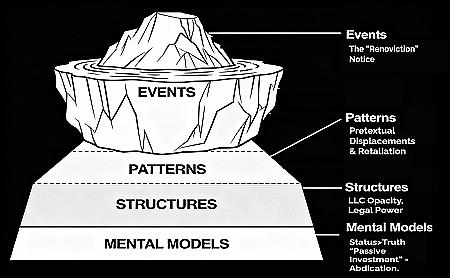
    Iceberg systems thinking modelThis filing is not merely about one disputed sentence or one objection; it’s about whether discovery functions as truth-seeking or devolves into “blindman’s bluff,” requiring court intervention to restore the process.

    Plaintiffs contend the repeating pattern—ordinary terms labeled “vague,” factual questions labeled “legal conclusions,” and two firms deploying near-identical boilerplate—signals an improper purpose: delay, cost imposition, and avoidance of clean admissions. The intervention requested is a classic systems leverage move: force clean yes/no answers (or deemed admissions) so the case can converge on real disputed issues rather than semantic fog.

    The key point, systemically, is that compelling “clean admit/deny” responses is a real intervention—but it is not the highest leverage move. It is closer to a rule-enforcement / structural correction that treats symptoms; the highest leverage is at the mental model level: what the court and counsel assume about:

    1. truth,
    2. status, and
    3. pro se competence.

    Iceberg LevelCurrent State in This CaseTarget State (Truth-Seeking Model)
    Events

    Motion required because RFAs were met with recurring boilerplate objections, partial admissions embedded in denials, and “cannot admit/deny” posture on facts within Defendants’ control.

    RFAs operate as designed: clean admissions narrow issues, clean denials clarify disputes, and “reasonable inquiry” explanations are specific and accountable.

    Patterns

    Repeating pattern: ordinary terms labeled “vague,” factual acts reframed as “legal conclusions,” and mirrored language across multiple parties—suggesting a coordinated evasion template rather than individualized, good-faith answering.

    Pattern of disclosure integrity: answers track ordinary meaning; objections are rare, specific, and actually supported; parties either admit/deny or identify exactly what record/inquiry would resolve uncertainty.

    Structure

    Incentives reward “fog”: cost imposition, delay, and asymmetric burden-shifting—especially against pro se litigants, where opponents may expect skepticism toward competence and higher tolerance for gamesmanship.

    Structures reward clarity: court expectations and case-management norms treat evasiveness as noncompliance; discovery is evaluated by functional truth-seeking output (clarity, verification, narrowing issues), not by credential-driven performance theater.

    Mental Models

    • ABP* (Status/Gatekeeper model): If a perceived “higher-status” party conflicts with a lower-status party, then credibility follows rank, meaning truth is licensed, not verified.
    • ABP* (Pro se suspicion model): If a pro se litigant produces sophisticated work, then it must be “improper,” meaning competence is treated as evidence of cheating.
    • ABP* (Discovery-as-combat model): If discovery can be turned into semantic fog, then that is “effective defense,” meaning truth-seeking is secondary to attrition.

    • TLP* (Merit-based integrity model): If status is treated as noise and argument strength as signal, then the stronger position wins, meaning court integrity and fairness prevail over hierarchy.
    • TLP* (Pro se respect model): If a pro se litigant produces sophisticated work, then they may be autodidactic and innovating, meaning competence deserves engagement—not suspicion.
    • TLP* (Discovery-as-convergence model): If discovery is designed to converge the case on real disputes, then gamesmanship is treated as system waste, meaning clarity is the win.

    * ABP = Audience Baseline Position, TLP = Thought Leadership Position

    Leverage ladder

    Ordered clean admit/deny answers (and deemed admissions where warranted) are best framed as a mid-level leverage intervention: it reduces fog and forces convergence. Higher leverage is achieved when the Court explicitly signals the mental-model standard: credibility is grounded in verification, pro se status is not a proxy for incompetence, and discovery tactics are evaluated by whether they help the Court reach accurate resolution efficiently

    Explore More Case Pages

    Court Memo Details $350K+ Probate Valuation Gap Linked to Affordable Housing Board Member

    Court Memo Details $350K+ Probate Valuation Gap Linked to Affordable Housing Board Member

    Court Memo Details $350K Probate Valuation Gap Linked to City Affordable Housing Board Leadership.

    Pro Se Tenants Continue to Face Exploitative Tactics When They Seek Justice

    Pro Se Tenants Continue to Face Exploitative Tactics When They Seek Justice

    An Analysis of How Court Procedures, Counsel Conduct, and Information Asymmetry Perpetuate Housing Injustice Even After Litigation Begins

    Defense AI Disclosure Motion: Pre-AI Case History Disproves Competence Suspicion

    Defense AI Disclosure Motion: Pre-AI Case History Disproves Competence Suspicion

    Lawyers Question Pro Se Competence, Miss Basic Docket Search Showing Strategic Legal Arguments Pre-AI Against Their Own Client
    Why Systems Thinking and Strategic Thought Leadership in Housing Justice?

    Why Systems Thinking and Strategic Thought Leadership in Housing Justice?

    As systems thinker Russell Ackoff said, "A bad system will beat a good person every time."

    The Altman Files: When Public Trust Meets Private Extraction

    The Altman Files: When Public Trust Meets Private Extraction

    Court Filing Reveals City Affordable Housing Commissioner Linked to 95% Asset Devaluation, "Flash Transfers," and Displacement of 5-Year Tenants in Good Standing.

    Discovery Is Not a Word Game: Motion to Determine Sufficiency of Defendants’ RFA Response

    Discovery Is Not a Word Game: Motion to Determine Sufficiency of Defendants’ RFA Response

    When “vague and ambiguous” becomes a strategy, Requests for Admission stop narrowing issues and start hiding them. Motion seeks court intervention after defendants deployed coordinated "vague and ambiguous" boilerplate to avoid clean admissions.