The Health Crisis Filings: Tenant Harm Weaponized Through Defense Gaslighting
Defense Claims 'Threats' After Criminal Complaint Filed, Gaslighting Pattern Produces PCL-5 Score of 76/80, Co-Plaintiff Intervenes as ADA Accommodations Requested
Document Overview
Charleston County Court of Common Pleas Case number: 2025-CP-10-05095
Filing Date: January 28, 2026
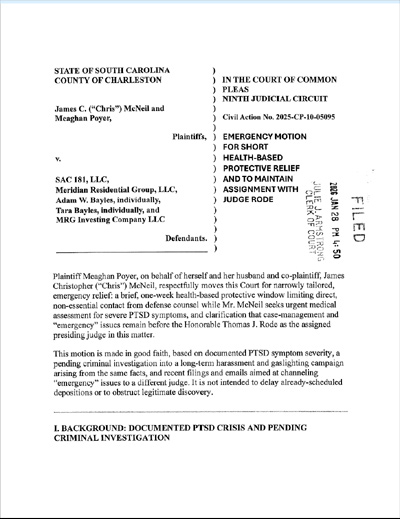
Document: Emergency Motion for Short Health-Based Protective Relief and to Maintain Assignment with Judge Rode
Contents: Motion filed by Meaghan Poyer on behalf of herself and co-plaintiff Chris McNeil requesting:
- one-week protective window limiting non-essential adversarial contact during medical crisis,clarification that case remains with Judge Thomas J. Rode,
- remote deposition accommodations for February 2 and February 9, 2026 depositions, and
- leave to seek further accommodations after medical assessment.
Key Evidence: PCL-5 PTSD score of 76/80 (severe range), gaslighting-severity score of 79/80 (extreme range), Charleston County Sheriff's Office investigation #2026-001263 initiated January 26, 2026.
Charleston County Court of Common Pleas Case number: 2025-CP-10-05095
Filing Date: January 30, 2026
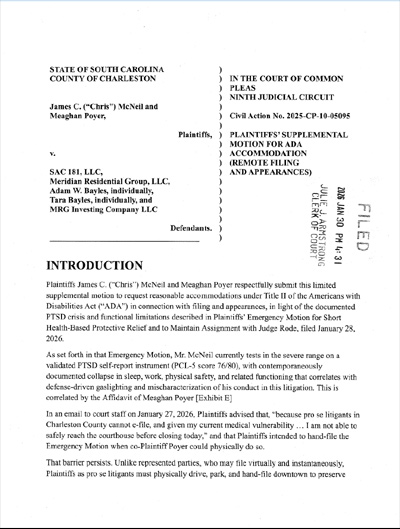
Document: Plaintiffs' Supplemental Motion Regarding ADA Accommodations
Contents: Supplemental motion requesting ADA Title II accommodations for disabled pro se litigant, including:
- electronic filing access or email-to-file alternative,
- remote appearance option for non-evidentiary hearings, and
- clarification of "gaslighting" as clinically significant trauma pattern documented through validated instruments.
Legal Basis: Title II of the Americans with Disabilities Act and implementing regulations requiring reasonable modifications to court procedures to avoid discrimination on basis of disability.
Executive Summary
On January 26, 2026 - after three months of what Plaintiffs describe as coordinated litigation gaslighting - pro se plaintiff Chris McNeil filed a criminal complaint with the Charleston County Sheriff's Office (Investigation #2026-001263) against property manager Tara Bayles for alleged forgery, harassment, and obstruction of justice.
Two days later, he suffered a severe mental health crisis documented at PCL-5 score 76/80 (severe PTSD range) and gaslighting-severity score 79/80, forcing his wife and co-plaintiff Meaghan Poyer to intervene for the first time in the litigation.
Within 72 hours, Plaintiffs filed two emergency health-based motions that serve dual purposes:
- Immediate survival measures requesting minimal court accommodations to prevent further potentially permanent neurological harm, and
- Systemic evidence documenting how crude tactics like procedural volume, mischaracterization, and coordinated denial can replace intelligent, nuanced legal arguments against pro se litigants.
The motions do not seek delays - the February 2 SAC 181 deposition (now missed - SAC 181 was a no-show) and February 9 LLR investigator deposition (which the LLR is attempting to quash) remain on calendar - but rather targeted relief: a one-week communications buffer, remote technology access, and e-filing capability.
The Gaslighting Pattern: Not Rhetoric, Clinical Reality
Plaintiffs clarify that "gaslighting" is used precisely, not casually: a sustained pattern, across multiple defense firms and attorneys, of litigating as if the documented traumatic events simply never occurred. It is not that defense counsel contests Plaintiffs' evidence of falsified postmarks, 24+ platform image syndication, or LLR investigation obstruction. They do not even acknowledge these events exist in the record.
This erasure-via-omission forces Plaintiff McNeil to repeatedly re-prove that documented harms actually happened, compounding post-traumatic stress in ways contemporary institutional-betrayal literature identifies as a predictable trauma multiplier. When defense counsel then recharacterized McNeil's January 26 criminal-complaint notice as "threats to lawyers and their families" - without attaching the actual email for court review - Meaghan Poyer broke her months-long silence with a single, powerful email to court staff and all counsel.
Meaghan's Intervention: The First Voice Acknowledging Reality
- Validation After Months of Denial: "What they are doing is a direct example of the ongoing pattern my husband has been documenting for months... They act as though the retaliatory eviction never occurred. They act as though our images were never posted online without consent."
- Court Accountability: "And they are doing this openly, in front of the Court. And the Court is allowing it."
- Call to Judge Rode: "I know that Judge Rode has recently taken a strong stand against the weaponization of the legal process in this county. I am asking that you ensure he sees this email immediately."
What This Reveals: A live case study in how procedural sophistication - motions to quash, protective orders, sanctions threats, "emergency" judge-shopping emails - can be deployed not to contest facts but to erase facts from the litigation narrative, inflicting compounding psychological harm on pro se parties while attempting to maintain plausible deniability.
Plaintiffs are documenting this pattern in real time, both for immediate court intervention and as systemic evidence for the transparency aspect of the Rocket's Fight housing-justice reform campaign.
The Criminal Complaint That Triggered Defense Escalation
On January 26, 2026, McNeil met with Charleston County Sheriff's Deputy Achey and filed a formal criminal complaint against property manager Tara Bayles, focusing on three alleged violations:
Alleged Criminal Acts (Investigation #2026-001263)
- Forgery / False Pretenses (SC § 16-13-10, § 16-13-240): Creating fraudulent "E-MAILED 8/28/2025" stamp to justify withholding $2,295 security deposit and avoid treble-damage penalty under SC § 27-40-410 (felony threshold >$2,000).
- Harassment, Second Degree (SC § 16-3-1700): Three-month coordinated campaign of psychological distress continuing after multiple written objections and civil filings; clinical assessment shows 79/80 gaslighting severity with physical manifestations.
- Common Law Obstruction of Justice: Interference with SC Real Estate Commission LLR investigation #2025-566 into Tara Bayles' PMIC license (statutory deadline February 20, 2026).
The Strategic Email and O'Brien's Overreaction
When McNeil sent a courtesy notice of the criminal investigation to defense counsel and the Altman property owners on January 26, which including standard evidence-preservation cautions and disclosure of his severe PTSD symptoms, he deliberately wrote it in the formal, carefully worded style typically used for Rule 408 settlement communications. However, McNeil intentionally did not invoke Rule 408 protections and included no settlement amounts or offers, leaving the email fully discoverable.
Defense counsel Kevin O'Brien apparently assumed the email carried Rule 408 confidentiality protections, believing McNeil could not immediately share it with the court to refute mischaracterizations. O'Brien seized on this perceived opening, characterizing the professional notice as "threats against lawyers and their families" and seeking an "emergency status conference" with a different judge than the one assigned to the case. Meridian Counsel Alicia Bolyard followed O'Brien's lead - as court records show she consistently does - and apparently did not notice McNeil's prompt reply clarifying the email's non-Rule-408 status and providing the full text directly to court staff with a "read it for yourself" invitation.
The defense gambit failed: the email contained no threats, only clinical documentation of harm and standard evidence-preservation language. McNeil's breakdown occurred two days later, on January 28, forcing Meaghan to take over communications and file the emergency motions.
What the Motions Request—And What They Don't
Narrow, Time-Limited Relief (Not Case Delays)
Plaintiffs emphasize that no depositions are being postponed. The (missed - they no-showed) February 2, 2026 deposition of SAC 181, LLC and the February 9, 2026 deposition of the LLR investigator in Columbia remain on calendar. Plaintiffs view these as critical to exposing the full scope of misconduct. What they seek:
From Emergency Motion (Jan 28):
- Seven-Day Communications Buffer: Temporary pause on non-essential adversarial emails/contacts while McNeil seeks urgent medical assessment; settlement communications explicitly permitted.
- Judge Assignment Clarification: Confirmation that case-management issues remain with Judge Thomas J. Rode (for whom Judge McCoy granted continuance in December) rather than being routed to Judge Van Slambrook via "emergency" styling.
- Remote Deposition Tech: Zoom access for Feb 2 and Feb 9 depositions without requiring defense consent, given PTSD-related travel/confrontation limitations.
- Leave for Further Accommodations: Ability to update Court after medical assessment on whether additional supports or outside counsel association is needed.
From ADA Supplemental Motion (Jan 30):
- E-Filing Access: Registration for Court's existing electronic filing system (or email-to-file alternative if registration unavailable to pro se), so disability does not force sole reliance on co-plaintiff's work-hour courthouse trips.
- Remote Hearing Participation: Zoom option for non-evidentiary hearings (status conferences, motion arguments) with 24-hour notice, rather than requiring stipulation from counsel who have opposed even minor procedural courtesies.
Why This Matters Systemically: Represented litigants already enjoy e-filing and routine remote conferencing. Extending analogous access to disabled pro se litigants is precisely the "reasonable modification" Title II requires. Yet it took a defense-misconduct triggered mental health crisis and a sheriff's investigation to prompt the request. That gap itself is evidence of structural barriers Rocket's Fight aims to reform.
The Judge-Shopping Attempt and Meaghan's Firewall
On January 27-28, 2026, defense counsel sent emails requesting an "emergency status conference" and explicitly addressing Judge Van Slambrook rather than Judge Rode, who had been presiding over the case since motions were originally set for December 19, 2025. Counsel for the Meridian defendants wrote:
"If Judge Van Slambrook needs or wants any other documents or information from us at this time, we will be happy to provide."
McNeil, in crisis, managed to respond on January 27 clarifying his understanding that the case remained assigned to Judge Rode. But it was Meaghan Poyer's January 29 email - her first direct communication in the litigation - that cut through the procedural maneuvering with moral clarity:
"I am Meaghan Poyer, the Co-Plaintiff in this case and Chris's wife. Up until now, I have been silent in these proceedings, running support in the background for Chris and writing affidavits to document the human damage going on. But after reading the email exchange from yesterday and the day before, I need to speak up now.
I ask the Court to take careful notice of Ms. Bolyard's comments and Mr. O'Brien's written statement from yesterday, and to review the email they referenced - Chris attached it for you. There was no physical threat at all in Chris' email. What they are doing is a direct example of the ongoing pattern my husband has been documenting for months.
The impact to his physical and mental health has become so severe that he had to call the police, because even after months of such filings, this Court took no action to protect him. As a result, we are now facing concerns of permanent brain injury, reflecting potential lifelong impacts of PTSD due to this situation.
What is happening to him is not confusion or misunderstanding. The individuals involved are coordinating a consistent false narrative, and the manner in which they are doing it is extremely damaging. There is a coordinated effort to gaslight him - multiple people repeating the same false story, as if rehearsed. The harm they are causing is profound.
They act as though the retaliatory eviction never occurred. They act as though our images were never posted online without consent. They erase the very events that traumatized him. This forces him to repeatedly relive the trauma because they deny events that are documented.
And they are doing this openly, in front of the Court. And the Court is allowing it.
I know that Judge Rode has recently taken a strong stand against the weaponization of the legal process in this county. I am asking that you ensure he sees this email immediately, so he can stop that exact same weaponization from happening in his own courtroom."
Plaintiffs later stated that Meaghan's intervention - the first voice in the litigation context (other than McNeils's) to acknowledge that the documented traumas really happened - may have prevented further deterioration of McNeil's mental state by breaking the isolation gaslighting requires.
The Open Letter to the Altmans: From Legal Filing to Public Manifesto
Parallel to the emergency health motions, McNeil published and is iteratively updating an Open Letter to Jonathan S. Altman and Charles S. Altman at RocketsFight.org, transforming the private experience of litigation trauma into public systems analysis. The letter employs systems thinking (reinforcing loops, leverage points, paradigm shifts) and direct moral challenge:
Key Framing from the Open Letter
- The Vicious Cycle: "I ask the system for justice. The system responds by punishing me for asking, by elevating the harm it causes, in order to force me to stop. I bring in a different resource or strategy... The system responds by punishing me at a yet higher level." (Includes interactive diagram)
- The Endpoint Question: "From my perspective, if I insist on justice, no matter what the cost to myself, the logic of this loop forces me to ask how far you are willing to let that escalation go... to the point of permanent neurological harm that leaves me too impaired to outthink your lawyers."
- Paradigm Shift as Leverage: "The system can't change until the property owners change their thinking and you are the ones whose thinking has created my suffering. That's my leverage for changing the system: your thinking."
- The Hypocrisy Exposed: Addressing Jonathan Altman's role as former chair of Charleston's affordable housing initiative while profiting from the property at the center of the case: "Why are you continually funding a machine that I am demonstrating is geared to smash the vulnerable tenant in need of stable housing and housing justice, instead of helping them?"
The Open Letter will be progressively updated as the case evolves, with extensive development notes already drafted for next stages.
For questions about these filings or the impact of gaslighting in litigation, contact:
Chris McNeil, Pro Se Plaintiff
Email: Click here to email with web form
Case: 2025-CP-10-05095, Charleston County Court of Common Pleas
Document Access
Emergency Motion for Short Health-Based Protective Relief and to Maintain Assignment with Judge Rode
To Top
 Unable to view the pdf on your mobile device?
Download the PDF
Plaintiffs' Supplemental Motion Regarding ADA Accommodations
To Top
 Unable to view the pdf on your mobile device?
Download the PDF
SYSTEMS VIEW: Litigation Gaslighting as Structural Violence
Iceberg Level |
In This Health Crisis Episode |
What It Reveals |
Intervention Leverage |
|---|
Events |
Jan 26: Criminal complaint filed. Jan 27: Defense emails claim "threats," seek emergency hearing with different judge. Jan 28: McNeil breakdown, emergency motion filed by Meaghan. Jan 29: Meaghan's intervention email. Jan 30: ADA motion filed. |
Health crisis as predictable outcome of sustained adversarial gaslighting; judge-shopping attempt when criminal investigation initiated. |
Immediate: 7-day buffer, remote tech, e-filing. Medium: sanctions for mischaracterization, costs for gimmick motions. |
Patterns |
3-month pattern of litigating as if documented events (falsified postmark, image syndication, LLR obstruction) never occurred; reframing victim safety measures as "threats"; opposing basic procedural courtesies (email service stipulation, remote depositions). |
Systematic erasure of record evidence + inversion of victim/aggressor roles (DARVO: Deny, Attack, Reverse Victim and Offender) as litigation strategy. |
Docket review for pattern evidence; Rule 11 scrutiny; referral to disciplinary authorities if crime-fraud exception applies. |
Structures |
Pro se litigants barred from e-filing; no penalty for speculative "emergency" motions; no court mechanism to compel acknowledgment of record evidence before arguing law; insurers fund scorched-earth defense with no exposure cap visible to plaintiffs. |
System structurally rewards volume-over-merit litigation against under-resourced parties; disability accommodations require crisis-level documentation rather than being proactively available. |
Uniform e-filing access for all parties; ADA compliance as baseline, not exception; cost-shifting for bad-faith procedural motions; transparency in insurance policy limits. |
Mental Models |
Old: "Tenants are transactions; resistance is noise to be suppressed. Pro se sophistication signals AI or coaching, not competence. Lawyers' procedural maneuvers are 'zealous advocacy' regardless of human cost."
New (Rocket's Fight): "Tenants are stakeholders in a shared system; their resistance signals design flaws. Pro se competence reflects access-to-justice innovation. Litigation is a truth-seeking process, not a war of attrition." |
Paradigm shift from extraction to stewardship; from status-based to evidence-based credibility; from adversarial theater to collaborative problem-solving. |
Public narrative change via Rocket's Fight campaign; model briefs/talking points at HousingJusticeAudit.com; this case as live systems audit generating reform blueprints. |