The SC Supreme Court Missing Writ
How a Four-Day Documentary Test Exposed Selective Docket Suppression at South Carolina's Highest Court.
Document Overview
Supreme Court of South Carolina, Appellate Case No. 2026-000919
Documentation Period: May 11–15, 2026
Document: SC Supreme Court Docket Visibility Anomalies - Documentary Record
Contents: Side-by-side docket captures showing 16 publicly-listed Original Jurisdiction Extraordinary Writs, the SC Supreme Court's written policy assertion that such writs are not publicly docketed, before-and-after screenshots of the Hicks v. extraordinary writ erasure within a four-day window, and the full email correspondence with appellate staff
Executive Summary
On May 11, 2026, Petitioner McNeil wrote the SC Supreme Court, stating, among other things,
Petitioners are not presently finding the Petition on the public docket. Please advise when it will appear, or whether any additional step is needed from Petitioners for docket visibility.
On May 12, 2026, a Case Management Specialist from the Supreme Court of South Carolina emailed the self-represented Petitioner, stating "Original Jurisdiction cases are not posted on public ctrack".
During a phone call on May 13, 2026, McNeil was told by the same Case Management Specialist that "as a policy, they do not put non-attorney filings online" and went further to state that "all parties in a publicly posted filing must be represented", further stating that it was because of the risk of highly sensitive information being posted, pointing to "some pro se being prisoners" and referencing the burden of auditing such documents line-by-line as the issue.
Petitioner McNeil offered to audit the document and provide assurance nothing highly sensitive was in there, to save the burden. He was told she "can ask the Clerk of Court".
Later that same day, May 13, 2026, McNeil received an email from the Case Management Specialist stating "Please see the attached response from the Clerk of the Supreme Court."
That letter, from Patricia A. Howard, Clerk of the Supreme Court, stated "Extraordinary writs filed with the Supreme Court, including Petitions for a Writ of Mandamus, are not available on C-Track Public Access."
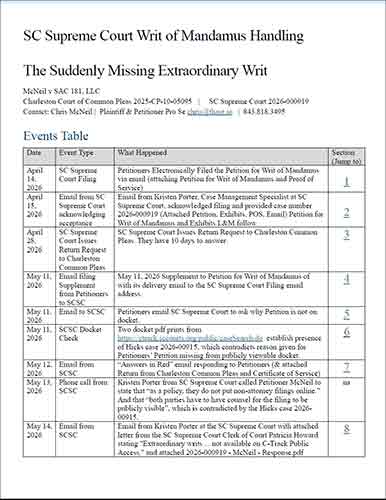
The same Court's own docket, searched on May 15, though, returned sixteen listings documenting such cases publicly listed. Within four days of the petitioner pointing this out, one of the cases - Rodney Ajaira Hicks v. S.C. Department of Social Services et al (2026-000915) - disappeared from the public docket without any apparent judicial order. Plaintiffs preserved the before-and-after captures, and they are depicted in the pdf below.
What the Record Shows
- The Stated Policy: SCSC written correspondence dated May 14, 2026 asserts Original Jurisdiction Extraordinary Writs are not posted on the public C-Track system.
- The Counterexample (May 15, 2026 Capture): A docket search using the Court's own filters — Group: Original Jurisdiction and Writs; Type: Extraordinary Writ; date range 5/1/2024–5/15/2026 - returned 16 rows associated with publicly-listed Original Jurisdiction Extraordinary Writs, including Hicks, Mills/Spero v. Toal, Bryant v. Anderson, Citizens Alliance v. York County, and the Tibbs asbestos cluster.
- The Erasure: Hicks (2026-000915) was visible on the public docket on May 11, 2026 and again on May 15, 2026. After Plaintiffs raised the visibility discrepancy with the Court, Hicks was removed from public visibility within the four-day window between May 15, 2026 and May 19, 2026 - in the days after the policy assertion issued.
- The Hidden Petition: Plaintiffs' own Petition for Writ of Mandamus (Appellate Case No. 2026-000919) - the case that triggered the inquiry - remains unlisted on the public docket.
What This Reveals: A documentary, falsifiable record that the Court's stated public-access policy is contradicted by the Court's own docket, and that the only case demonstrating the policy is fictional was selectively removed within a week after the inquiry - a side-by-side, dated, screenshot-grounded contradiction.
Why This Matters Now
The May 28, 2026 hearing in McNeil & Poyer v. SAC 181, LLC et al. (Case No. 2025-CP-10-05095) follows a 200+ day delay on Plaintiffs' (unopposed on the docket for 179 days) Motion for Leave to File the Second Amended Complaint and a 116-day delay on Plaintiffs' federal-statutory ADA accommodation motion - including a request for the same electronic-filing access defense counsel enjoys 24/7. The SC Supreme Court's April 28, 2026 return-request letter placed that local pattern under active supervisory review. The selective docket suppression of Plaintiffs' Petition, paired with the documented Hicks erasure, is the appellate-level mirror of the same access-asymmetry pattern playing out in the trial court.
This page exists so that journalists, oversight bodies, and other pro se petitioners whose filings may have been quietly erased have a stable, citable record of the documentary anomalies. The full PDF below preserves the captures, the email correspondence, and the comparisons in their original form.
The Four-Day Window: Timeline of the Erasure
- April 28, 2026: SC Supreme Court issues return-request letter in Appellate Case No. 2026-000919, placing the local Ninth Circuit motion-blackout pattern under supervisory review.
- May 11, 2026: Plaintiffs print and preserve a public docket capture showing Hicks (2026-000915) listed as a publicly-visible Original Jurisdiction Extraordinary Writ.
- May 11, 2026: Plaintiffs send written inquiry to SC Supreme Court appellate staff regarding the visibility of their own pending Petition (2026-000919) and the visibility of comparable extraordinary writs.
- May 14, 2026: SC Supreme Court issues written response asserting that Original Jurisdiction extraordinary writs are not publicly docketed on the C-Track system.
- May 15, 2026: Plaintiffs run the same public docket search using the Court's own filters and capture sixteen publicly-listed extraordinary writs — but Hicks, visible four days earlier, is gone.
The Sixteen Rows of Publicly-Listed Extraordinary Writs (May 15, 2026 Capture)
The May 15 capture preserved in the PDF below shows sixteen rows referencing such cases, including Mills/Spero v. Toal (2026-000383), Bryant v. Anderson (2025-002187), Citizens Alliance v. York County (2025-002174), the Tibbs asbestos cluster, and others.
The full list, dated and timestamped, is preserved in the PDF.
A Presumption of Openness That Cannot Be Overcome Silently
The First Amendment right of public access to judicial proceedings - including dockets - is established under Press-Enterprise Co. v. Superior Court, 478 U.S. 1 (1986)(Press-Enterprise II), and Richmond Newspapers, Inc. v. Virginia, 448 U.S. 555 (1980).
Richmond Newspapers established a heavy constitutional presumption of openness. To legally close a proceeding or hide a record (such as a docket sheet), a court cannot rely on informal policy statements, administrative convenience, or silent removals.
Under the Press-Enterprise II standard, a court may only restrict access if it meets strict constitutional hurdles:
- The court must make specific, on-the-record factual findings.
- It must prove that closure is essential to preserve a higher value (e.g., national security or protecting a victim's identity).
- The closure must be narrowly tailored so that no broader than necessary information is hidden.
By removing case 2026-00915 and hiding 2026-00919 without a formal, written order containing these specific findings, the SCSC's actions directly clash with Press-Enterprise II.
For questions about this documentary record and the May 28, 2026 hearing, contact:
Chris McNeil, Pro Se Plaintiff
Email: Click here to email with web form
Case: 2025-CP-10-05095, Charleston County Court of Common Pleas
Document Access
SC Supreme Court Docket Visibility Anomalies — Documentary Record (McNeil v. SAC 181, Appellate Case No. 2026-000919)
To Top
 Unable to view the pdf on your mobile device?
Download the PDF